



One of the most common causes of back pain is osteochondrosis.According to statistics, about 80% of people suffer from this pathology.However, not all patients can answer exactly what osteochondrosis is.This is a chronic disease that affects the cartilage and bone tissue of the spine.Degenerative-dystrophic changes can affect any part of the spine or several at the same time.
In order to get rid of the disease faster, it is necessary to start treatment when the first signs of pathology appear.But many people simply do not notice them, and then the pathology develops and becomes more severe.
It is necessary to treat osteochondrosis complexly: drugs, exercise therapy, physiotherapeutic procedures, etc. In case of complications (intervertebral hernia, radiculitis, leg paralysis), surgical intervention may be required.
What is this
Osteochondrosis is a chronic disease in which the intervertebral discs and bone tissue of the spine are damaged.
The spine consists of 33-35 vertebrae, between which there are cartilage cushions (vertebral discs).They consist of a pulpous core and a fibrous ring (outer part);they are lined on both sides by dense, flexible vitreous hyaline cartilage.Thanks to the intervertebral discs, the spine becomes more flexible and mobile.
With osteochondrosis, metabolic processes and blood circulation in the spine are disturbed.Under the influence of negative factors, the discs between the vertebrae become less strong and elastic, and their volume decreases.The spine shrinks and the cartilage cushions decrease in height.
The central gelatinous part of the disk first swells and then dries, then the cushioning of the spine is disturbed.The outer shell becomes thinner and cracks appear on it.When the gelatinous substance leaks there, protrusions (protrusion) are formed.An intervertebral hernia is diagnosed when the outer part of the disc tears and the nucleus pulposus protrudes.
Osteochondrosis disease manifests itself with discomfort, impaired mobility, and pain in the affected area.When hernias are formed, neurological disorders occur: back pain spreading to the upper or lower limbs, numbness of the arms, legs, groin, involuntary urination or defecation, etc.
Please help.Previously, osteochondrosis was mainly diagnosed in patients over 40 years of age.Now the disease is more and more detected in young people (from 16 to 30 years old).It is usually associated with a sedentary lifestyle.
Reasons
Degenerative-dystrophic changes in cartilage and bone tissue occur due to uneven load on the elements of the spine.Then, where there is excessive pressure, destruction of the intervertebral discs occurs.Many negative factors can cause the pathological process.

The main causes of osteochondrosis:
- Injuries after a fall or impact.
- Congenital anomalies of the spine, genetic predisposition.
- Metabolic disorders due to poor nutrition, the appearance of excess body weight.
- Infectious diseases.
- Excessive stress on the spine during vigorous sports or heavy physical work.
- Chemicals that enter the body through food or air.
- Frequent vibration, for example, from drivers.
- Straight legs.
- Wrong posture.
- Passive lifestyle, for example, among people with sedentary jobs (office workers, drivers).
- Smoking.
- Prolonged exposure to adverse weather conditions (low temperature and high humidity) in the body.
- Wearing anatomically incorrect shoes (narrow or heeled).
- Frequent stress.
- Pregnancy etc.
Often, the disease manifests itself in people who carry a heavy load in one hand, are in the wrong position for a long time, sleep on an excessively soft mattress or a high pillow.The probability of developing the disease increases with age-related changes related to metabolic processes or blood supply to the vertebrae.This risk increases if a person often changes the position of the body, bends, straightens or bends the body.
ReferenceOsteochondrosis is often diagnosed in tall people who are bent and have a weak muscle corset.Carriers, professional athletes, construction workers and office workers are also at risk.
Types of osteochondrosis
As already mentioned, the pathology can affect different parts of the spine.Depending on the location, the following types of osteochondrosis are distinguished:
- Lumbar is the most common type of disease, because the load on the lumbosacral segment is quite high.The pathology is accompanied by pain in the lumbar region, which can spread to the legs, groin, and in the later stages, neurological disorders occur (impairment of sensitivity of the lower body).
- Cervical - also common.Degenerative-dystrophic changes are associated with weakness of the neck muscles, so there is a risk of vertebral displacement even with minimal exposure.It manifests itself as pain that can spread to the upper limbs, cephalalgia (headache), hearing and vision disorders.
- It is the rarest form of thoracic pathology.This is due to the fact that the mobility of the thoracic segment is minimal;in addition, it is protected by the ribs, back and abdominal muscles.It is quite difficult to identify the disease because its symptoms are similar to those of other diseases.
Also, there is osteochondrosis of several parts or the entire spine at once.This type of disease has the most severe course.
ReferenceAccording to medical statistics, osteochondrosis of the lumbar segment occurs in 50% of patients, cervical - 25%, thoracic - up to 10%.In 12% of cases, several parts of the spine are affected at once.
Classification of osteochondrosis depending on its stage:
- Stage 1- the initial stage of the pathology, which is manifested by the dehydration of the nucleus pulposus, the decrease in the height of the cartilage pad, and the appearance of cracks in its outer part.At this stage, it is very difficult to diagnose the disease, because there are no clear symptoms yet.If the patient stays in a certain position for a long time or actively moves, the injured area experiences mild discomfort.The pathology has a slow course, a hidden form.It is discovered incidentally during an X-ray, MRI or CT scan of the back.
- Stage 2- at this stage, the space between the vertebrae decreases, the surrounding muscles and ligaments sag, and the possibility of protrusion and displacement of the spinal elements increases.The cartilage cover begins to deteriorate, which is accompanied by pain.Without proper therapy, displaced discs or vertebrae can compress nerve bundles, muscles, and blood vessels.It is easier to identify the disease at this stage.Complex conservative therapy is performed.
- Stage 3- the outer part of the disc is destroyed, protrusions and tears are formed.In addition, the risk of subluxation increases and arthrosis of the intervertebral joints may develop.The patient experiences severe pain and loss of sensation (tingling or numbness) that may spread to the upper or lower extremities.
- Stage 4- due to the excessive flexibility of the joints of the spine, bone growths appear at their contact points, so the body tries to improve the fixation of the neighboring vertebrae.Osteophytes often compress nerve ligaments and damage the elements of the spine.The risk of ankylosis increases, which leads to immobility of the joints.The patient has severe pain, neurological disorders, it becomes difficult to move.If left untreated, it can be disabling.
Osteochondrosis is a chronic disease, it is important to be notified in time to avoid dangerous complications.
Symptoms
The first symptoms of the disease are discomfort and stiffness in the affected area.The patient's back gets tired faster, pains occur from time to time.Then spinal osteochondrosis in adults is complemented by other symptoms.Clinical manifestations depend on the stage and location of the affected area.Therefore, patients should know how the pathology of the cervical, thoracic and lumbar spine differs.This will allow you to see the warning signs in time and seek medical help.
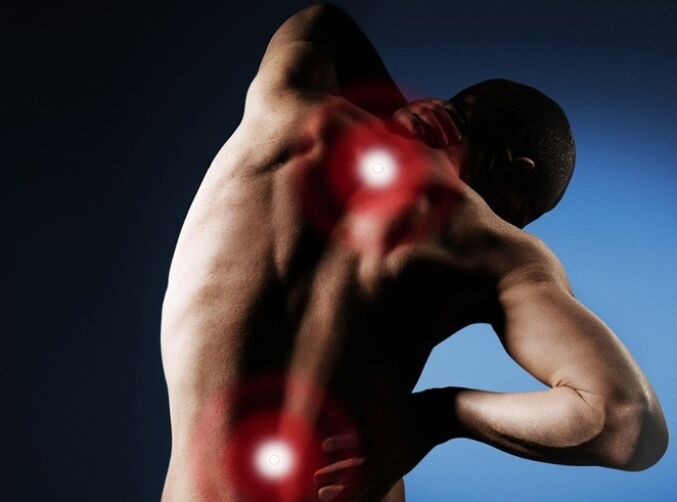
Symptoms of spinal osteochondrosis affecting the cervical spine:
- aching or stabbing pain that may radiate to the upper back, neck, or arms;
- increased muscle tone around the affected area that can be felt by palpation;
- cephalgia that worsens during movement and is not relieved by analgesics;
- dizziness with sudden turns of the neck;
- visual impairment manifested by "spots" or spots in front of the eyes;
- hearing disorders (noise or ringing in the ears);
- weakness of neck or shoulder muscles;
- loss of sensitivity in the neck and hands;
- rarely, the patient's tongue becomes swollen and numb.
This type of pathology is observed mostly in office workers.
Clinical manifestations of osteochondrosis of the lumbar-sacral segment:
- aching or sharp pain in the lower back;
- discomfort increases when the patient moves;
- the pain syndrome can spread to the lower part of the body (hips, groin, legs);
- neurological disorders manifested as numbness, tingling, coldness in the groin, hips, legs;
- weakness, thinning of the leg muscles.
In some cases, due to severe pain, the patient cannot straighten, turn or bend his back.He tries to take a position that alleviates the anxiety.
Degenerative-dystrophic changes in the thoracic segment of the spine are accompanied by the following symptoms:
- periodic sharp pain in the chest, shoulder blades, which increases when lifting the upper limbs, bending over;
- pain is more pronounced at night, after hypothermia, physical exertion;
- violation of skin sensitivity;
- chest tightness;
- Sharp pain may appear between the ribs during movement.
ReferencePatients often confuse thoracic osteochondrosis with heart disease.However, during the first pathology, the pain increases with breathing and is not relieved by nitroglycerin.
When several parts of the spine are affected at the same time, specific symptoms appear.
Treatment methods
Treatment should be started after the doctor has diagnosed osteochondrosis.The treatment plan is drawn up by the doctor taking into account the degree of the disease, its causes and the general condition of the patient.
The following methods are used during diagnosis:
- Radiography.
- CT or MRI.
- Ultrasound of the spine.
- Myelography.
- Neurological tests.
In addition, the patient may be prescribed laboratory tests.
Treatment of spinal osteochondrosis should be comprehensive.Depending on the severity, it lasts from 4 to 8 weeks, then maintenance therapy is carried out for a long time (about a year).This will help consolidate the results and prevent relapses.
Your doctor will tell you what to do if you have osteochondrosis.Treatment usually begins with the application of conservative methods: taking medications, conducting therapeutic exercises, physiotherapy, massage, etc. Surgical intervention is performed only in cases where the pain does not go away for a long time after drug treatment, there are neurological disorders, or the disease progresses rapidly.
Conservative methods will help to get rid of pain and other unpleasant symptoms, normalize the functionality of the spine and prevent complications.
Medicines reduce the symptoms of the disease, improve blood supply and tissue trophism, accelerate the healing of damaged areas.For this purpose, the following drugs are used:
- Anti-inflammatory drugs help relieve inflammation and pain.
- Antispasmodics help relax tense muscles and relieve pain.
- Preparations with antioxidant effect, for example, vitamin C, tocopherol, thioctic acid.
- Vasodilators and B vitamins are used to improve blood supply to the injured area.
- Preparations based on chondroprotectors, hyaluronic acid, glucosamine and chondroitin are used to accelerate recovery or stop the further development of degenerative processes.
ReferenceThe fight against severe pain is carried out with the help of therapeutic blockades.The drug is injected into the affected area.If steroid drugs are added to local anesthetics, the therapeutic effect will last longer.This therapy method is used when traditional methods (medications, rest, physical therapy) are ineffective.
The following conservative methods will help in the treatment of osteochondrosis:
- Physiotherapy procedures will help relieve pain and increase the effectiveness of drugs.In addition, they are used during the period of remission, when there are no severe symptoms.The most commonly used treatment methods are ultrasound, laser treatment, magnetic therapy, diadynamic therapy, electrophoresis with the use of painkillers and anti-inflammatory drugs.
- Therapeutic gymnastics helps to correct posture, strengthen the muscles of the back, abdomen, sides, and ligaments, normalize muscle tone, and relieve pain associated with compression of nerve ligaments.Regular exercise will help improve blood circulation, nourish the damaged vertebral discs and speed up their recovery.
- Kinesitherapy - safe exercises on special simulators.This technique allows you to remove the axial load from the spine, restores microcirculation in the deep muscles, helps to relieve pain, spasm, swelling and normalize the functionality of the damaged area.
Important.A series of exercises for osteochondrosis is designed by the doctor individually for each patient.It is recommended to conduct the training under the supervision of an instructor.

- Massage also helps fight osteochondrosis as part of complex therapy.Therapeutic procedures improve blood flow to the spine, relax spasmodic muscles and improve tissue trophism.The very popular water body massage, in addition to the effects described above, normalizes the state of the nervous system.
- Manual therapy is the effect of the therapist's hands on the patient's body.Treatment methods are selected separately for each patient.After the course of treatment, blood circulation is normalized, metabolic processes in the damaged area improve, its mobility is improved, and the immune system is strengthened.Manual therapy helps prevent complications of osteochondrosis.The main thing is to find an experienced specialist.
- Stretching is the stretching of the spine using weights and special simulators.The procedure helps to eliminate vertebral displacement, increase the intervertebral space and correct irregularities in the spinal structure.
- Acupuncture - exposure to biologically active points of the body with thin sterile needles.Acupuncture helps to relax tense muscles and reduce pain.
To improve the condition, the patient is recommended to sleep on an orthopedic mattress.If your work involves sitting for a long time, then you need to buy a chair with an orthopedic back, get up from time to time and do exercises for your back.In addition, stress and hypothermia should be avoided.
Chondrosis and osteochondrosis: what is the difference
Chondrosis and osteochondrosis are related conditions.However, many patients do not understand the difference.
Back chondrosis is a disease that affects cartilage tissue.With osteochondrosis, degenerative-dystrophic changes spread to the vertebrae and surrounding tissues.This is the main difference between these two pathologies.That is, chondrosis is the first stage of osteochondrosis.
The causes of chondrosis and osteochondrosis are not different.However, they manifest themselves in different ways.
With chondrosis, the cartilage tissue wears out, its composition changes or becomes thinner.For this reason, the intervertebral discs can no longer fully perform the function of shock absorption.
Now you know the differences between chondrosis and osteochondrosis.
Symptoms of chondrosis
As already mentioned, it is very difficult to identify the pathology at the first stage, because it has a gradual course.Therefore, when bone tissue is affected, chondrosis is detected more often, that is, osteochondrosis develops.
Spinal chondrosis is manifested by the following symptoms:
- increased back fatigue;
- incorrect posture;
- slight impairment of spinal mobility in the injured area;
- sometimes mild back pain.
If you notice at least one manifestation of the disease, it is recommended to consult a doctor.Then it will be possible to stop the process of cartilage destruction.
X-ray or MRI is recommended to identify chondrosis.The latter study is more informative because it allows observing the smallest changes in the cartilage structure.
Treatment of chondrosis
In order to prevent the transformation of chondrosis into osteochondrosis, it is necessary to carry out complex treatment.For this purpose, the patient is prescribed anti-inflammatory drugs, chondroprotectors, and vitamins.Physical therapy helps improve spinal mobility and strengthen muscles.Therapy can be completed with physiotherapeutic procedures and reflexology.
Reviews
Most of the patients who started the treatment of the disease on time are satisfied with the results of the therapy.The pain and stiffness in the spine disappeared.However, in order to achieve such results, it is necessary to implement a number of measures.
- Male, 38 years old: "I was diagnosed with lumbar osteochondrosis in the second stage. The doctor injected for 1.5 months and prescribed 10 massage sessions. In addition, he started therapeutic exercises. After the course, the pain went away. I will repeat the course in a month to consolidate the results."
- Woman, 45 years old: "I couldn't get up because of pain related to osteochondrosis. The doctor prescribed me injections, massages, magnetic therapy. I also tried to exercise every day, took chondroprotectors. After finishing the course, the pain disappeared."
- Woman, 44 years old: "I got rid of childhood osteochondrosis of the neck twice. He gave complex treatment: drugs, physiotherapy, massage, exercise therapy, swimming pool. But 3 years after the last treatment, severe pain and numbness appeared in the neck, shoulder blade, arm area. I went to the doctor and asked for an MRI. The neurosurgeon who prescribed the operation, he has not bothered me for a year.
The most important
Osteochondrosis is an insidious disease that is difficult to detect in the 1st stage and can be confused with other pathologies.When the first signs of the disease appear (discomfort, stiffness in the damaged area), it is better to consult a doctor, then it will be easier to treat it.It is important to carry out complex therapy: drugs, exercise therapy, massage, physiotherapy, manual therapy, etc.If conservative methods do not help for more than 6 months, if there are neurological disorders or other serious complications, surgical intervention cannot be avoided.